Signed in as:
filler@godaddy.com
8.15.26 I by JANEL ST. JOHN I PART 1
To be Black in America today is still, too often, to exist in a state of hyper-vigilance. As James Baldwin famously observed in 1961: “To be a Negro in this country and to be relatively conscious is to be in a state of rage almost, almost all of the time... It isn't only what is happening to you. But it's what's happening all around you and all of the time in the face of the most extraordinary and criminal indifference…”
Decades later, that atmosphere of psychological strain remains relentlessly present in our daily news feeds - from the mysterious deaths in Mississippi, including Nolan Wells and Tasia Fortune, to persistent police violence. Even generational homeownership - a foundational pillar of Black stability - is under siege from predatory deed theft in historically Black NYC neighborhoods, prompting direct legislative action from the Mayor's Office. This cumulative exhaustion has triggered a profound social shift. Across the country, Black women are actively rethinking their historic roles as America's reliable political organizers, choosing instead to prioritize rest, mental health, and personal well-being over charging to the front lines of endless political battles. Yet the reality of Black pain, pushback, and politics, tell an incomplete story.
Enter Derrick Adams: View Master - now on view at the Institute of Contemporary Art Boston - which places the radical necessity of Black joy, leisure, and imagination directly at the center of the frame. The Baltimore-born, New York-based Adams has built a practice around portraying people during times of rest, recreation, play, and friendship, creating what he has described as a form of ‘Black radical imagination.’ He consistently transforms ordinary moments of Black life into subjects worthy of attention, pleasure and contemplation. Viewmaster, his first mid-career survey, brings together more than 100 works spanning 25 years, including painting, sculpture, collage, performance, video and public projects.
“Idea of play and relaxation and leisure and the idea of Black joy to me, are all things that I consider, could be considered political,” he said. "When you go to a museum and as a Black person, a lot of the traumatic experiences that have kind of formed our identity are also included in exhibitions. So for us, going to an exhibition is not necessarily the most leisurely, fun, uplifting experience, because we also are taunted with the reality that we exist within outside of those spaces. What I’m interested in, is offering another aspect of Black culture and Black life that is also real."
For Adams, depicting Black people simply being - swimming, lounging and relaxing - is not an escape from American history. It is part of that history. His goal however, is to expand the visual record. His landmark Floater series directly subverts the historical exclusion of Black Americans from public pools and beaches. In We Came to Party & Plan, which reclaims the constitutional right to assemble, Adams flips centuries of spatial restriction on its head. "Black radical imagination can still prosper," he told fellow artist Mickalene Thomas, in an interview. "We're still prospering. We’re still thriving. We’re still surviving. We're still enjoying our family and friends. We have time where we can actually reflect. Or do nothing at all."
______
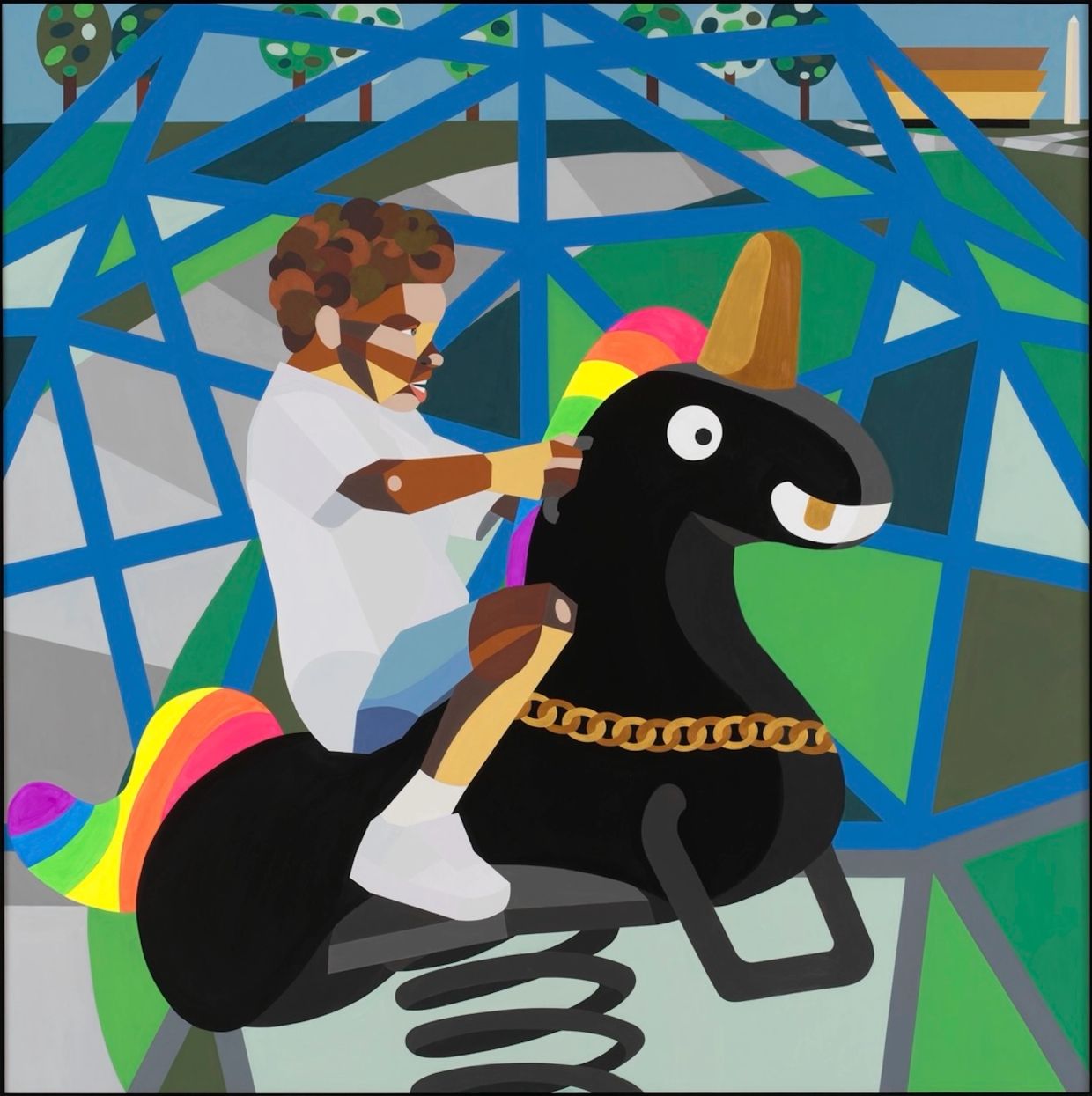
Artwork above: Derrick Adams, Braving the Path, 2023. Acrylic on panel in artist frame. 61 × 61 × 2 1/2 inches (154.9 × 154.9 × 6.4 cm). Collection of Hooman and Tiffany Dayani, Beverly Hills, California

Amy Sherald made her Mid-Atlantic debut this spring with American Sublime, her mid-career survey. Artwork: What's precious inside of him does not care to be known by the mind in ways that diminish its presence (All American). 2017. Private Collection, courtesy Monique Meloche Gallery. © Amy Sherald. Photo by Joseph Hyde, courtesy the artist and Hauser & Wirth
See Derrick Adams: Viewmaster at the Institute of Contemporary Art Boston thru Sept. 7. Artwork: Figure in the Urban Landscape 17, 2018. Acrylic, graphite, ink, fabric, paper, grip tape, and model carson wood panel.48×48×9 inches (121.9 × 121.9 × 22.9 cm).
Courtesy Marquez Family Collection, Miami.

Adams is not alone in imagining Black joy as something worthy of protection, preservation and public space. Around the country this season, museum curators and other artists of color are following suit - transforming gallery spaces into sanctuaries of respite, joy, play, and unbridled imagination. Visitors have the opportunity to experience something that can feel almost radical in its simplicity...a place to breathe.
At a moment when so much of the national conversation has returned Black Americans to questions of safety, belonging, exclusion, and survival, these exhibitions make room for another set of questions. What does it mean to rest? To imagine? To gather? To be seen in joy?
And perhaps most importantly: What does it mean for museums to make room for those experiences as part of the American story? These exhibitions offer some compelling answers. Here's a list of must-see exhibitions to gather, pause, feel, reflect, and renew, over the next few months.
______
Artwork above: Wangari Mathenge, The Ascendants XIV (She is Here), 2021. Oil on canvas, 85 × 64 inches (215.9 × 162.56 cm). Collection of the Nasher Museum of Art at Duke University, Durham, NC. Museum purchase with funds provided by Colleen and Javier Baz, 2022.5.1. © Wangari Mathenge, 2021. Courtesy of the artist and Roberts Projects, LA.
Artwork below: Danielle Mckinney, Read the Room, 2024, Oil on linen 18x24in.(45.7x61cm) Forman Family Collection

Danielle Mckinney
Tyler Mitchell:Time for a New Sky II, billboard

Danielle Mckinney, Shelter, 2023, Oil on linen 20x16in.(50.8x40.6cm) Private Collection

Keisha Scarville: Where Salt Meets Black Water, vinyl reproductions of archival inkjet prints

Sanford Biggers, Dagu (2016), merging antique quilts, cultural symbolism, and sculptural abstraction
Kwame Brathwaite (Brooklyn, New York, 1938–2023, New York, New York). Untitled (Model Who Embraced Natural Hairstyles at AJASS Photoshoot), circa 1970, printed 2018. Pigmented inkjet print, 60 × 60 in. (152.4 × 152.4 cm). The Dean Collection, courtesy of Swizz Beatz and Alicia Keys. © Kwame Brathwaite.
(Photo: Joshua White /JWPictures.com)
Horace Ove, Walking Proud, Notting Hill Carnival, c. 1972, printed 2023, inkjet print image/sheet: 34 x 24 in., National Gallery of Art, Alfred H. Moses and Fern M. Schad Fund, 2025.43.3 © Sir Horace Ové
Derrick Adams. Dew Drop Inn. 2023. Baltimore Museum of Art Joseph Education Center. Photo by Mitro Hood.
